
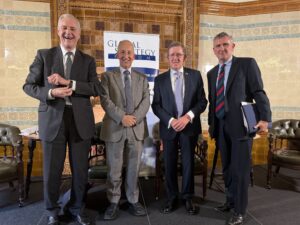
 On Tuesday 7th July, we were delighted to welcome an expert panel to GSF: the Rt Hon the Lord Robertson of Port Ellen KT GCMG, GSF Co-Chair and Lead Reviewer of the 2025 SDR, Secretary General of NATO (1999-2003) and Defence Secretary (1997-1999); Lord Ricketts GCMG GCVO, UK Ambassador to France (2012-2016), National Security Advisor (2010-2012) and UK Permanent Representative to NATO (2003-2006); and General (Retired) Sir James Everard KCB CBE, NATO Deputy Supreme Allied Commander Europe (2017-2020). They discussed ‘The Future Of NATO: Adapting To A New Security Landscape’ in an event chaired by Professor Michael Clarke, GSF Advisory Board Member & Director-General of RUSI (2007-2015).
To watch the event, please click here.
Background
As NATO leaders prepare to meet in Ankara on 7-8 July, the Alliance faces one of its most consequential strategic debates since the end of the Cold War. At June’s defence ministers meeting, in what he termed ‘NATO 3.0’, US Defense Secretary Pete Hegseth announced a six-month review of the presence of US forces in Europe and he pressed ‘free-riding’ allies on the issue of greater burden-sharing and responsibility for their own security. This reflects Donald Trump’s long-standing scepticism both of the Alliance’s value and the extent of current US NATO commitments, a stance which was seemingly reinforced by his frustration over European allies’ refusal to support the US military action against Iran.
In the UK, a political row over defence spending has erupted amid deep concerns that in the ‘most dangerous security environment in decades’ in the words of Mark Rutte, NATO Secretary General, Britain is both under-prepared and under-resourced. With the Russia-Ukraine war now in its fifth year, senior British military and intelligence officials have issued stark warnings that Russia could pose a direct threat to the UK in the coming years, through the targeting of critical national infrastructure, democratic processes, supply chains and public trust.
Against this backdrop, are NATO priorities diverging, as the dispute between the US and Europe over the status of Greenland in January seemed to suggest? Does Washington increasingly view Russia primarily as a regional challenge for Europe rather than a direct strategic threat to the United States? How should European members respond to the uncertainties over Ameria’s future commitment to NATO and how can this be reconciled with the pressures on national defence budgets in the current difficult economic climate? What does NATO’s future look like in an age of great power competition – can the Alliance maintain unity in an era of changing warfare and mounting geopolitical risk, or are we entering a new phase in the history of transatlantic security?
SPEAKER BIOGRAPHIES
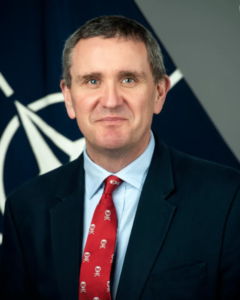 GENERAL (RETIRED) SIR JAMES EVERARD joined the 17th/21st Lancers in 1983. He commanded the Queen’s Royal Lancers, 20th Armoured Brigade, 3rd Division, and the UK Field Army. He also served as the Deputy Chief of the Defence Staff (3*) for Military Strategy & Operations based in the UK Ministry of Defence. His final appointment was as the Deputy Supreme Allied Commander Europe (April 2017-April 2020)/Operation Commander European Union Operation ALTHEA, Bosnia-in-Herzegovina (March 2017–March 2019). Between 2021-2025 he was the Lead Senior Mentor in Allied Command Operations NATO, primarily focused on the implementation and refinement of Allied plans for the deterrence and defence of the Euro-Atlantic Area. He now works across Europe, with a portfolio of work focused on future war, including his role as Chairman of Anders de Wiart Associates.
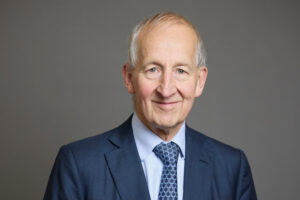
cHouse of Lords
LORD RICKETTS was a British diplomat for 40 years. He was UK Permanent Representative to NATO from 2003-2006 and Permanent Under Secretary at the FCO 2006-2010. In 2010 he was appointed Britain’s first National Security Adviser and set up the National Security Council. His final post in the public service was Ambassador in France from 2012 to 2016. Peter became a cross-bench member of the House of Lords. He has recently stepped down as Chair of the European Affairs Committee after three years in the role. He remains heavily engaged with foreign policy and security issues in the Lords and has recently been appointed UK Special Envoy for the loan of the Bayeux Tapestry. Peter is a Non-Executive Director of Eurotunnel. His charitable roles include Chairman of the Franco-British Council, President of the Normandy Memorial Trust, and Vice-Chairman of the Royal United Services Institute. His new book is Peace Makers: The Men And Women Of The Foreign Office In WWII.
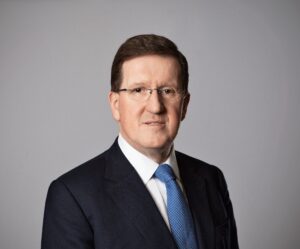 LORD ROBERTSON is Chancellor of the University of Dundee & Vice-Patron of the Royal Edinburgh Military Tattoo, and he is a Senior Counsellor with The Cohen Group in Washington DC. He led the UK Government’s 2025 Strategic Defence Review. He was the 10th Secretary General of NATO and Chairman of the North Atlantic Council from 1999-2003 and UK Secretary of State for Defence from 1997-1999. He was MP for Hamilton and then Hamilton South from 1978-99 and joined the House of Lords in 1999. He was born in Port Ellen, Islay of Islay, Scotland and educated at Dunoon Grammar School and Queens College, University of St Andrews when it became the University of Dundee where he took his MA(Hons) Economics degree. He is a Trustee of the British Forces Foundation, an Elder Brother of Trinity House, chairs the Ohrid Group (friends of North Macedonia), and he was a member of the House of Lords Select Committee on International Affairs & Defence. He is a Senior Adviser to Chatham House and is on the Advisory Council of the Centre for European Reform, and the International Advisory Board of the US Atlantic Council.