
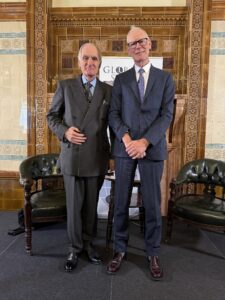
 On Wednesday 18th March, we were delighted to welcome back to GSF, Sir Simon Gass GCMG CVO, Chair of the Joint Intelligence Committee (2019-2023); leader of the UK team in the 2015 Iran Nuclear Agreement negotiations; and UK Ambassador to Iran (2009-2011).
In a lecture entitled ‘Iran And The West – Can’t We Be Friends?’, he discussed recent developments and what comes next for Iran, the Middle East and the West’.The event was chaired by Lord Stirrup KG GCB AFC, GSF Advisory Board member, and Chief of the Defence Staff (2006-2010).
To watch the event, click here.
SPEAKER BIOGRAPHY
SIR SIMON GASS joined SC Strategy in 2024 and advises clients on a wide range of geopolitical issues. From 2019 to 2023, he served as Chair of the Joint Intelligence Committee and the Adviser on Intelligence to successive British Prime Ministers. His diplomatic career included Ambassador to Greece and Iran, and NATO’s Senior Civilian Representative to Afghanistan. Simon was also the Foreign Office’s Political Director, overseeing policy on a wide range of geographies and institutions. He led the UK team in the Iran Nuclear Agreement negotiations. He is a Distinguished Fellow at RUSI, non-executive chair of the UK Foreign Office’s commercial arm, Visiting Professor at King’s College London and a frequent media commentator.
Event Background
Following weeks of rising tensions and the largest military build-up in the Middle East since 2003, the United States and Israel have carried out joint strikes against Iran in a dramatic escalation of hostilities and an unprecedented push toward regime change in the country. Tehran has retaliated with attacks on US assets across the region and as casualties mount, the conflict has already widened to include Iranian-backed militias in Lebanon. This raises the prospect of a prolonged war with global repercussions.
The killing of Iran’s supreme leader Ayatollah Khamenei is a seismic moment, but one which is likely to mark the beginning, not the end, of this crisis. Although much of Iran’s senior leadership is reportedly eliminated and key military infrastructure destroyed, the regime has vowed to avenge Khamenei’s death. Now locked in a battle for its own survival, can it cling to power or does this signal the end? And if it does, what will follow? As many commentators have observed, decapitation strikes and ‘regime change’ conflicts often reshape regimes rather than ending them outright – as in Afghanistan. In a video posted on Truth Social, President Trump has called on the Iranian people to rise up and overthrow their government. But although tentative protests had started again, memories of the regime’s brutal crackdown on protesters in December in which thousands were killed are still very fresh and many may be cautious to take the risk again.
In the UK, in a change of position, Keir Starmer has given permission for the US to use British bases, including Diego Garcia, for defensive strikes on Iranian missile sites. This marks a shift from his previous refusal on legal grounds and the UK government’s preference for a diplomatic solution to the standoff over Iran’s nuclear ambitions. Hours after the announcement, RAF Akrotiri in Cyprus was targeted in a suspected drone attack, and contingency plans are now underway for a large-scale evacuation of British nationals from the region.
As the risk of broader Middle East instability grows, it remains to be seen whether the White House’s calculus in Operation Epic Fury pays off and compels Iran to curb its nuclear and missile programmes and enter a new era of government, or whether we are at the start of a protracted conflict with global implications which will spread across the region, destabilise energy markets, and foment terrorism.